Anthropic brings Claude agents to small businesses
Anthropic's new small-business package connects Claude to everyday tools and workflows, signaling that AI agent competition is moving beyond enterprise pilots and into owner-operated work.
News summary
Anthropic is packaging Claude for the owner-operator market.
Anthropic introduced Claude for Small Business as a focused package for small companies, solo operators, local businesses, agencies, and lean teams. The product connects Claude to tools that already sit inside the small-business workflow, including QuickBooks, PayPal, HubSpot, Canva, DocuSign, Google Workspace, and Microsoft 365, according to Anthropic and Axios.
The package runs through Claude Cowork and emphasizes practical workflows across finance, operations, sales, marketing, HR, and customer support. Anthropic is also taking the launch on the road with free half-day AI fluency workshops for small business leaders, beginning May 14 in Chicago and continuing across ten U.S. cities.
Key details
The launch is about workflows, connectors, and signoff.
The most important product decision is the connector strategy. Small businesses usually do not want a blank canvas where they must imagine an agent from scratch. They want help where work already lives: invoices, customer records, contracts, email, spreadsheets, design briefs, and campaign assets.
Anthropic is presenting Claude as a coworker that can prepare work, coordinate across tools, and keep the human operator in control. Axios reported that Anthropic says there is no extra charge beyond Claude licenses and whatever partner tools a business already pays for, which matters because SMB buyers are unusually sensitive to hidden platform costs.
Finance workflows can help prepare invoice follow-ups, expense summaries, payroll inputs, and cash-flow review material.
Sales and customer workflows can summarize accounts, draft outreach, and organize next steps across CRM and email context.
Marketing workflows can turn briefs and performance notes into campaign drafts, social assets, and creative handoffs.
Operations and HR workflows can prepare documents, checklists, internal updates, and policy drafts for review.
Background
AI labs are moving from model demos to job-specific distribution.
The broader market context is clear: frontier model companies are no longer competing only on benchmark charts or general chat interfaces. They are racing to own recurring business workflows. Large enterprises have been the obvious first target because they have budgets, data platforms, procurement teams, and measurable productivity programs.
Small businesses are harder. They have less time to evaluate software, fewer technical staff, tighter cash constraints, and lower tolerance for complex implementation. But the payoff is large if the product works because millions of small companies share the same repetitive administrative pain: unpaid invoices, scattered customer notes, inconsistent marketing, contract follow-up, and after-hours operations work.
Analysis
The strategic bet is trust before autonomy.
Claude for Small Business is strongest when viewed as a trust-building product rather than a pure automation product. For many owners, the first objection to AI agents is not whether the model can draft a message. It is whether the system understands enough context, respects boundaries, and gives the owner a clear moment to approve the output.
That is why the product framing around Claude Cowork, tool connections, and guided workflows is important. A small business owner may not describe the need as agentic AI. They may simply want someone to reconcile a confusing week of expenses, prepare a vendor reply, assemble a marketing campaign, or summarize customer complaints before opening the shop tomorrow.
Industry impact
Small business could become the next AI agent battleground.
Anthropic is entering a market where the competitive set includes OpenAI's business plans, Microsoft Copilot inside Microsoft 365, Google Gemini inside Workspace, vertical SaaS vendors, and specialized automation platforms. The durable advantage may come less from the model alone and more from the quality of workflow templates, partner integrations, onboarding, and support.
The Canva partnership shows how this could develop. Canva says its role in Claude for Small Business is to help owners turn briefs and insights into editable campaign assets. That kind of vertical handoff is where AI agent products become commercially useful: not a standalone answer, but a completed step in a tool the business already understands.
Business implications
The buyer is not the CIO. It is the person doing the work.
Enterprise AI launches often assume a buyer with an IT team, a deployment plan, and a governance process. Small-business AI has a different adoption path. The buyer may be the founder, office manager, bookkeeper, agency lead, store owner, or solo consultant, and that person is often evaluating the tool while also running payroll, answering customers, and chasing sales.
That changes the product requirements. Successful SMB AI agents need fast setup, transparent pricing, plain-language workflow examples, reversible actions, and an obvious way to stop the system before it acts externally. Education also matters, which explains Anthropic's tour and workshop strategy. Training is not a marketing extra in this segment; it is part of the product.
Why it matters
The best AI agent products may look boring at first.
The most valuable early use cases are not always dramatic. They are operational: collect context, draft the email, prepare the invoice explanation, summarize the customer thread, flag missing fields, assemble campaign options, and produce a checklist before approval. These are the jobs that steal evenings from owners and create inconsistency as a business grows.
If Claude can make these jobs more repeatable without creating privacy, accuracy, or control problems, Anthropic gains a credible wedge into a market that has been under-served by enterprise-first AI tooling. If it cannot, the launch will become another reminder that small-business software has to be useful within minutes, not after a transformation program.
Future outlook
Expect more AI packages built around roles, not models.
The next phase of AI commercialization is likely to produce more role-specific and industry-specific packages: AI for contractors, clinics, agencies, restaurants, legal practices, creators, accountants, and local service businesses. Each package will need different connectors, defaults, review steps, and risk boundaries.
For Anthropic, the challenge is to translate its enterprise credibility into small-business habit. That means proving that Claude can reduce busywork without adding operational uncertainty. For competitors, the message is straightforward: the AI agent race is moving closer to the actual workplace, and the interface that wins may be the one that understands the job before the user writes a prompt.
SEO metadata
Publishing notes for this article.
Suggested slug: claude-for-small-business-ai-agents. Focus keyword: Claude for Small Business. Related keywords: Anthropic small business AI, AI agents for small business, Claude Cowork, small business automation, AI business tools.
Open Graph title: Claude for Small Business: Anthropic's AI Agent Push. Open Graph description: Anthropic is taking Claude agents into small-business operations with tool connectors, guided workflows, and live AI fluency training. Canonical path: /blog/claude-for-small-business-ai-agents.
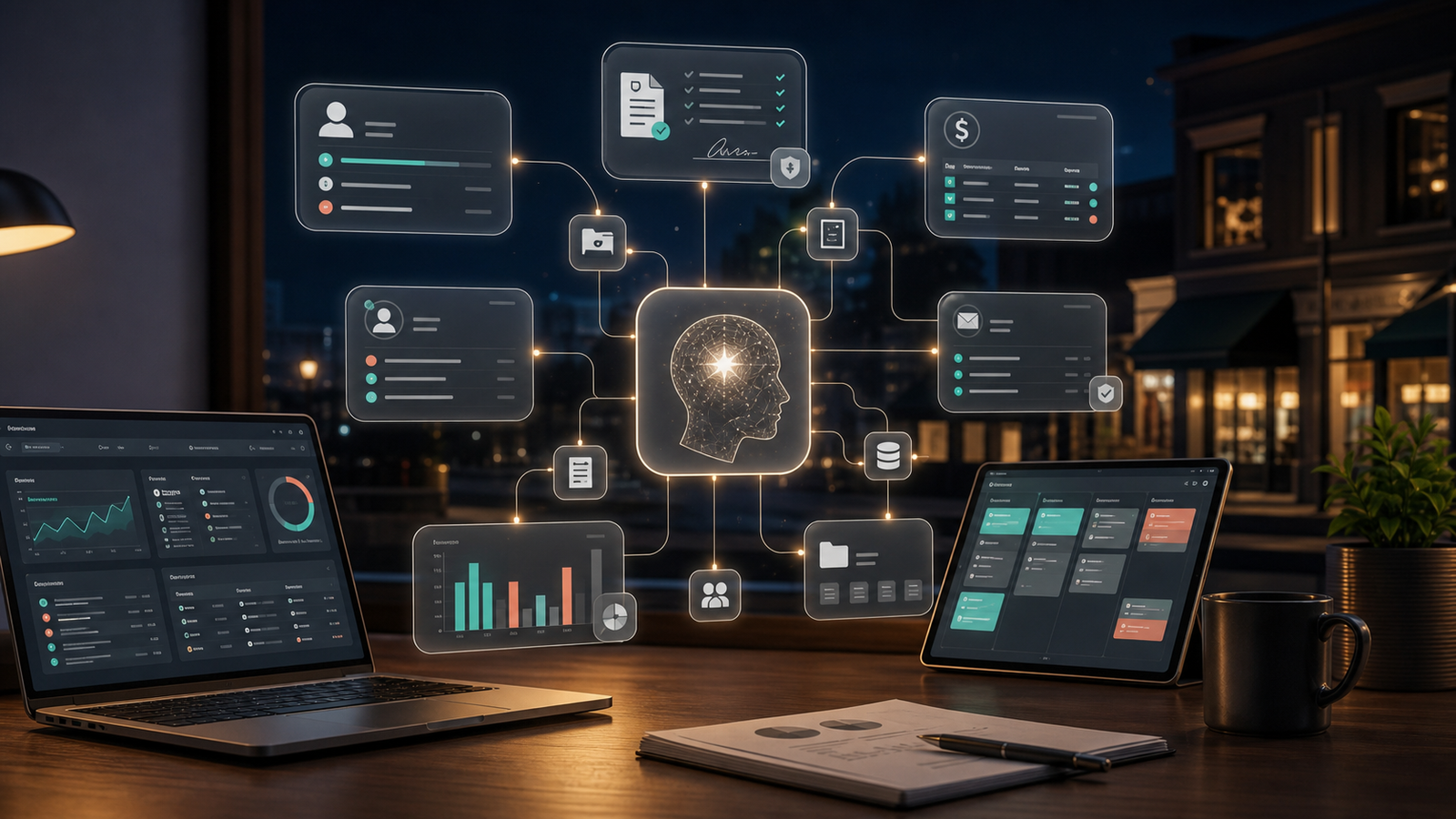
Image filename: claude-small-business-ai-agents.png. Alt text: Futuristic small-business operations desk with an AI assistant core connected to finance, sales, marketing, documents, and customer workflow panels. Placement: hero image at the top of the article.
Source references
Primary and reputable sources used.
This article is based on Anthropic's official announcement and product page, plus independent coverage from Axios and TechCrunch and a partner note from Canva. Claims about product positioning, connectors, launch timing, workshops, and partner workflows were checked against these sources before publication.
Related agent skill
Business Idea Validator Agent
Analyze a business idea across audience, problem intensity, monetization, competition, MVP scope, and launch risks.
Free NEOA resource
Use the free business idea validator
Turn this AI agent trend into a practical business workflow by testing the audience, pain point, offer, risks, and next steps before building.
View resourceFree prompt pack
Get the prompt pack behind practical AI workflows.
Download 50 prompts for SEO, content, research, and business automation, then use them with this guide to make the workflow repeatable.
Free download
Get the prompt pack.
Choose your main interest and unlock the Markdown download.
Free during NEOA beta. You can download after submitting the form.
FAQ
Common questions
What is Claude for Small Business?
Claude for Small Business is Anthropic's new package for small companies and lean teams, connecting Claude to common workplace tools and guided workflows across finance, operations, sales, marketing, HR, and customer service.
Which tools does Claude for Small Business connect to?
Anthropic and Axios list integrations or partner tools including QuickBooks, PayPal, HubSpot, Canva, DocuSign, Google Workspace, and Microsoft 365.
Why does this matter for AI agents?
It shows that AI agent competition is moving from abstract autonomy toward packaged workflows that help non-technical teams complete everyday business tasks with human review.
Should small businesses fully automate these workflows?
No. Sensitive workflows such as payroll, payments, legal commitments, HR decisions, and customer-facing messages should keep a clear human approval step.
Final recommendation
Make the workflow repeatable before you scale it.
Claude for Small Business is worth watching because it turns the AI agent race toward an underserved but difficult market. The winners will not be the tools with the most abstract autonomy. They will be the tools that make owner-operated workflows faster while preserving trust, review, and clear accountability.