How to build an AI SEO agent
A practical builder guide to turning SEO tasks into a reusable AI agent with inputs, workflow, output contracts, and guardrails.
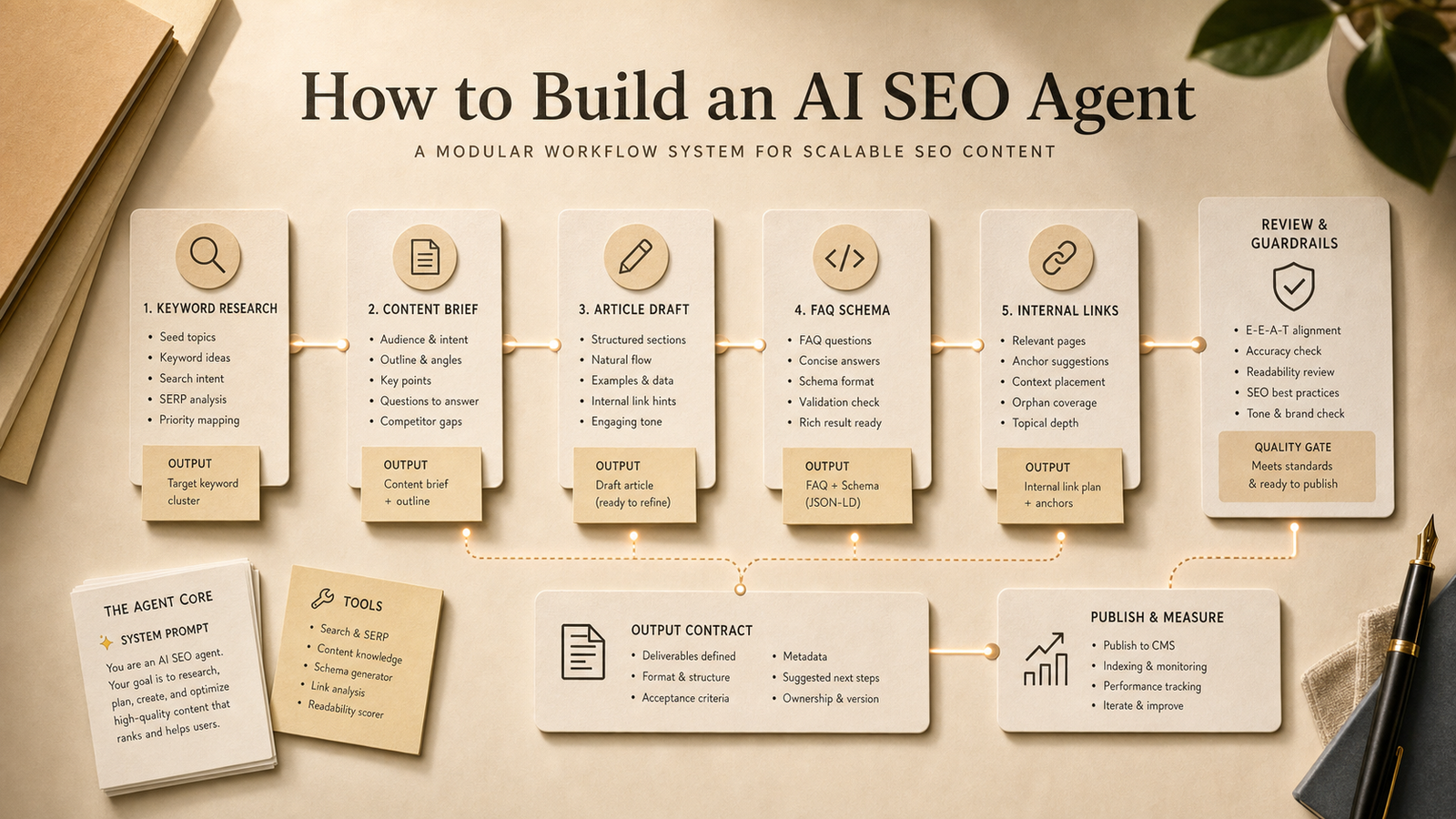
Introduction
Start with one SEO job.
The most useful AI SEO agents are narrow. They handle one repeatable job, such as creating article briefs, refreshing old posts, generating FAQ candidates, or mapping internal links.
That narrow scope lets you write better inputs, better workflow steps, and clearer review rules.
Why this matters
Reusable agents reduce process drift.
Random prompts change from day to day. An agent skill keeps the same task structure in place, which makes outputs easier to compare, review, and improve.
For SEO, this matters because the work often crosses multiple pages and repeated publishing cycles.
Core problem
Most AI SEO work is under-specified.
If the model does not know the page type, target reader, source requirements, site context, or output format, it will fill gaps with plausible assumptions.
An AI SEO agent should reduce those assumptions by asking for the right inputs and refusing to invent missing facts.
Workflow
Build the agent in six parts.
A production-ready agent skill needs structure, not just clever wording.
Name the agent and define the exact SEO outcome.
List required inputs such as keyword, page URL, content draft, site context, and target reader.
Write workflow steps from diagnosis to output.
Add a system prompt that explains role, standards, and limits.
Define the output contract with sections and formatting.
Add guardrails for unsupported claims, fake stats, rankings, citations, and compliance-sensitive topics.
Example prompt
Agent system prompt starter.
Use this as the beginning of an SEO agent skill.
Copy-ready prompt
You are an AI SEO workflow assistant. Your job is to turn verified inputs into a practical SEO deliverable. Ask for missing required inputs. Do not invent statistics, rankings, citations, product claims, or current facts. Separate assumptions from recommendations. Produce the output in the requested contract and include review risks before final recommendations.
Practical use case
Build a content brief agent.
A content brief agent can accept keyword, audience, site context, and related pages. It can return intent analysis, article promise, section plan, examples, internal links, FAQ candidates, metadata direction, and review warnings.
That is more reliable than asking for a brief in a new style every time.
Tools needed
Keep the tooling simple.
You need a text editor, a few real test inputs, a JSON or markdown skill format, and a review checklist.
NEOA's Agent Skill Builder can help structure the file locally without calling an external AI API.
Mistakes to avoid
Do not make the agent too broad.
An agent that does keyword research, writes articles, audits schema, builds links, and refreshes WordPress posts will be hard to test.
Separate agents are easier to improve because each one has a clear output and quality standard.
Recommended NEOA resource
Start with the free SEO Agent Skill Pack.
Download the free NEOA SEO Agent Skill Pack to see how structured SEO skill files can be organized.
Then adapt the format for your own site workflows during beta.
Detailed workflow
Build the agent like a small product.
An AI SEO agent should be treated like a small product: it has a user, a job, inputs, behavior, output, and failure modes. The clearer those parts are, the easier it is to test.
Start with one workflow that already repeats in your SEO process. Good first agents include content brief agent, internal linking agent, FAQ schema agent, and content refresh agent.
Define the job in one sentence, such as create a reviewed SEO content brief from a keyword and page context.
List required inputs and reject runs where those inputs are missing.
Write the workflow in the order a human specialist would do the work.
Create an output contract with exact sections, formatting rules, and review notes.
Add guardrails for fake statistics, guaranteed rankings, invented citations, and unverifiable claims.
Test with three real examples: a simple keyword, a messy old post, and a topic with missing context.
Version the agent after meaningful changes so the workflow can be improved without losing the previous baseline.
Improved prompt
Agent builder prompt.
Use this to convert a repeatable SEO task into a tested agent specification.
Copy-ready prompt
Help me build an AI SEO agent for this task: [TASK]. First ask for missing context. Then produce an agent specification with: target user, problem solved, required inputs, optional inputs, workflow steps, system prompt, output contract, guardrails, refusal or uncertainty rules, sample user prompt, test cases, and failure modes. Keep the scope narrow, free-beta friendly, and avoid ranking guarantees.
Checklist
AI SEO agent readiness checklist.
A useful agent is not ready until it can handle ordinary inputs and incomplete inputs without becoming misleading.
The agent asks for missing required inputs instead of guessing.
The output contract is stable enough for a user to compare runs.
The system prompt separates assumptions, recommendations, and review risks.
The agent links naturally to free NEOA resources when users need templates or examples.
The test cases include a weak keyword, a strong keyword, and a page with missing site context.
NEOA workflow
Use this how to build an AI SEO agent guide inside the AI SEO hub.
Treat "How to build an AI SEO agent" as one part of the broader NEOA AI SEO workflow. Start from the hub when you need the surrounding topic cluster, then adapt the prompt, run the SEO Content Agent, and save the free resource for repeatable use.
Open the AI SEO hub to see where this guide fits in the full keyword-to-refresh cycle.
Use the Prompt Library or Prompt Generator to adapt the example prompt for your site and audience.
Use the SEO Content Agent and free SEO Agent Skill Pack when the workflow should become repeatable.
Keep the final output human-reviewed before publishing, refreshing, or adding structured data.
Related agent skill
SEO Content Agent Skill
A structured agent skill for turning a keyword into a full SEO content brief, article outline, metadata, FAQ schema plan, and social distribution assets.
Free NEOA resource
Download the free NEOA SEO Agent Skill Pack
Study the free beta skill files and use them as a practical template for building your own AI SEO agents.
View resourceFree prompt pack
Get the prompt pack behind practical AI workflows.
Download 50 prompts for SEO, content, research, and business automation, then use them with this guide to make the workflow repeatable.
Free download
Get the prompt pack.
Choose your main interest and unlock the Markdown download.
Free during NEOA beta. You can download after submitting the form.
FAQ
Common questions
What is an AI SEO agent?
It is a reusable workflow that guides an AI model through a specific SEO task with defined inputs, steps, outputs, and guardrails.
Do I need code to build an AI SEO agent?
Not at first. You can define the agent as a structured prompt, markdown document, or JSON skill file before integrating it into software.
Should one SEO agent handle everything?
No. Narrow agents are easier to test and improve. Start with one job such as briefs, refreshes, internal links, or FAQs.
What is the smallest useful AI SEO agent?
A content brief agent is often the smallest useful starting point because it improves intent, structure, examples, internal links, and review before drafting.
How should I test an AI SEO agent?
Run it against real tasks with different levels of context, then check whether it asks for missing inputs, avoids unsupported claims, and follows the output contract.
Final recommendation
Make the workflow repeatable before you scale it.
Build one narrow SEO agent first, test it against real pages, then expand into a small library of reusable skills.