How to create SEO-friendly product pages with AI
A practical workflow for using AI to plan product pages that explain value clearly, answer buyer questions, and avoid unsupported claims.
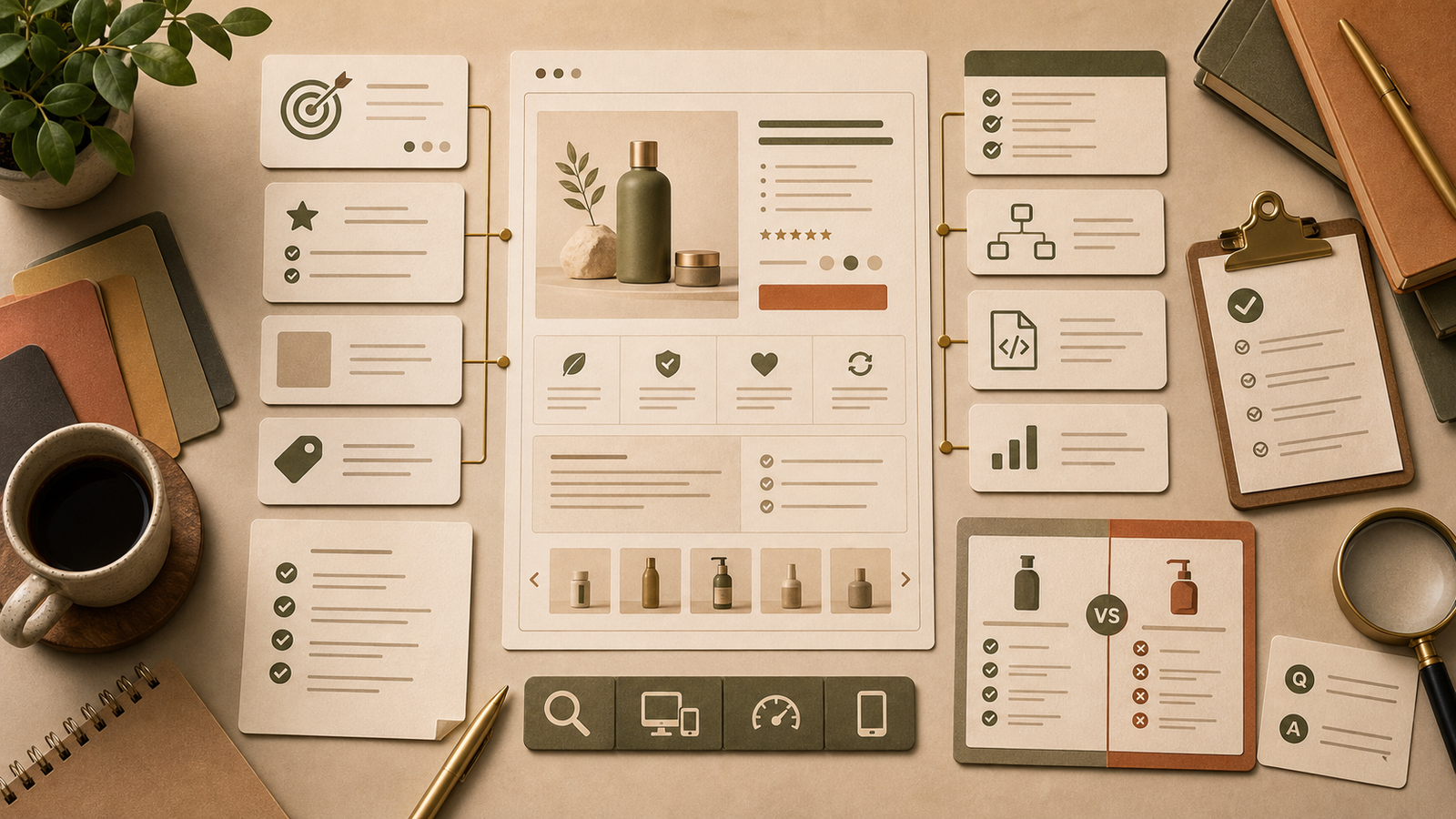
Introduction
Start with the SEO decision, not the AI output.
AI can help create SEO-friendly product pages by organizing buyer intent, product details, use cases, FAQs, internal links, and review checks.
Why this topic matters
AI is most useful when it improves repeatable SEO work.
Product pages need to answer practical questions. Readers want to know what the resource does, what is included, who it helps, and how to use it.
AI can turn raw product notes into a clearer page plan, but it should not create unsupported claims.
Core SEO problem
The problem to solve before scaling the workflow.
The core SEO problem is generic product copy. It can sound polished while failing to explain the actual resource.
The workflow should require inputs and review checks before drafting copy.
Step-by-step AI workflow
A product page workflow for AI-assisted SEO.
A strong product page is not a keyword container. It should help the buyer understand the product, who it is for, what is included, and what question to answer next.
Collect product details, audience, use cases, limitations, support notes, and related resources.
Ask AI to map buyer intent by awareness stage and decision questions.
Create a page brief with sections for outcome, details, examples, FAQs, and internal links.
Draft copy that is specific to the product and avoids vague benefit language.
Review claims, availability, compatibility, and policy details before publishing.
Add internal links to guides, prompts, resources, or dashboards where they help the user.
Example prompt
Copy-ready prompt starter.
Use this SEO-friendly product pages with AI prompt with one real page, one reader segment, and a short list of approved internal links. The goal is a reviewable workflow, not a one-click article draft.
Copy-ready prompt
Act as an SEO product page strategist. Use these verified product details [DETAILS], audience [AUDIENCE], use cases [USE CASES], limitations [LIMITATIONS], and related URLs [LINKS]. Create a page brief with buyer intent, page promise, outcome, included items, who it is for, practical examples, FAQs, internal links, metadata direction, and claims to verify. Do not invent features, outcomes, policies, or availability.
Practical example
What this looks like in real work.
For the NEOA SEO Agent Skill Pack, the page can explain included skill files, use cases, formats, and how to apply them with an AI assistant.
It can link to the AI SEO hub, Prompt Library, and SEO Content Agent so users can continue learning before downloading.
Checklist
How to create SEO-friendly product pages with AI review checklist.
Use this checklist before turning the SEO-friendly product pages with AI workflow into a saved template, prompt, or article update.
Confirm this step has a reviewable output: Collect product details, audience, use cases, limitations, support notes, and related resources.
Confirm this step has a reviewable output: Ask AI to map buyer intent by awareness stage and decision questions.
Confirm this step has a reviewable output: Create a page brief with sections for outcome, details, examples, FAQs, and internal links.
Confirm this step has a reviewable output: Draft copy that is specific to the product and avoids vague benefit language.
Confirm this step has a reviewable output: Review claims, availability, compatibility, and policy details before publishing.
Confirm this step has a reviewable output: Add internal links to guides, prompts, resources, or dashboards where they help the user.
Practical QA scorecard
Review the SEO-friendly product pages with AI workflow before saving it.
Before you turn this SEO-friendly product pages with AI process into a saved NEOA workflow, test it against one real page or article idea and check whether the output would help the reader make a better SEO decision.
The prompt includes the page type, reader stage, site context, and approved internal links.
The AI output separates facts, assumptions, missing inputs, and recommendations.
The workflow produces a concrete deliverable such as a brief, audit list, checklist, template, or refresh plan.
The result links naturally to the AI SEO hub, Prompt Library, SEO Content Agent, SEO Agent Skill Pack, and Prompt Generator when those next steps help the reader.
The final page keeps free beta language and avoids ranking guarantees, fake statistics, and invented proof.
Tools needed
Keep the stack simple and reviewable.
You need verified product details, use cases, limitations, related URLs, a review checklist, and a prompt workspace.
NEOA's free resources are a useful model because the page can focus on usefulness and implementation instead of complicated gating.
Mistakes to avoid
Where this workflow can go wrong.
For SEO-friendly product pages with AI, weak output usually looks polished while skipping context, verification, or reader-specific examples.
Letting AI invent product features, outcomes, policies, or availability.
Writing generic benefit copy that could apply to any product.
Skipping who-it-is-for and who-it-is-not-for clarity.
Adding FAQs that do not answer real buyer questions.
How to use this inside NEOA
Turn the workflow into a saved free-beta system.
Use the Prompt Generator to create a product-page brief prompt for your own resource.
Use the free SEO Agent Skill Pack as a reference for product page structure and resource explanation.
Recommended free NEOA resource
Download the free NEOA SEO Agent Skill Pack
Use the free resource page as a practical example of explaining what is included, who it helps, and how to use it.
Related agent skill
SEO Content Agent Skill
A structured agent skill for turning a keyword into a full SEO content brief, article outline, metadata, FAQ schema plan, and social distribution assets.
Free NEOA resource
Download the free NEOA SEO Agent Skill Pack
Use the free resource page as a practical example of explaining what is included, who it helps, and how to use it.
View resourceFree prompt pack
Get the prompt pack behind practical AI workflows.
Download 50 prompts for SEO, content, research, and business automation, then use them with this guide to make the workflow repeatable.
Free download
Get the prompt pack.
Choose your main interest and unlock the Markdown download.
Free during NEOA beta. You can download after submitting the form.
FAQ
Common questions
Can AI write product page copy?
AI can draft copy from verified details, but product features, policies, limitations, and claims must be checked before publishing.
What should an SEO-friendly product page include?
Include buyer intent, clear outcome, included items, who it is for, examples, FAQs, internal links, and metadata direction.
How do I avoid generic product copy?
Provide specific details, use cases, exclusions, examples, and review criteria instead of asking AI to write from a title only.
How do I keep SEO-friendly product pages with AI from becoming generic?
Start with specific inputs: page type, reader, intent, site context, examples, and approved links. Then use AI to expose assumptions and gaps before a human edits the final output.
Which NEOA resources should I use with this workflow?
Use the AI SEO hub to understand the cluster, the Prompt Library or Prompt Generator to adapt the prompt, the SEO Content Agent for repeatable execution, and the free SEO Agent Skill Pack for reusable workflow files.
Final recommendation
Make the workflow repeatable before you scale it.
Use AI to structure the page and expose gaps, then fill the page with verified product details and useful buyer guidance.