AI SEO
How to use AI to build topic clusters
A practical AI workflow for building topic clusters that connect hubs, guides, prompts, tools, resources, and reader next steps.
Introduction
Start with the SEO decision, not the AI output.
AI can build topic clusters when it is asked to define page jobs, reader stages, and internal links instead of only returning keyword lists.
Why this topic matters
AI is most useful when it improves repeatable SEO work.
Topic clusters help readers move from learning to implementation. That matters for NEOA because guides should connect to prompts, skills, tools, and resources.
AI makes cluster planning faster by showing possible hubs, supporting pages, gaps, and link routes.
Core SEO problem
The problem to solve before scaling the workflow.
The core SEO problem is overlap. Without clear page jobs, the cluster can become many similar articles that compete for the same intent.
The workflow should force each page to answer a distinct question or support a distinct action.
Step-by-step AI workflow
A topic cluster workflow for AI SEO.
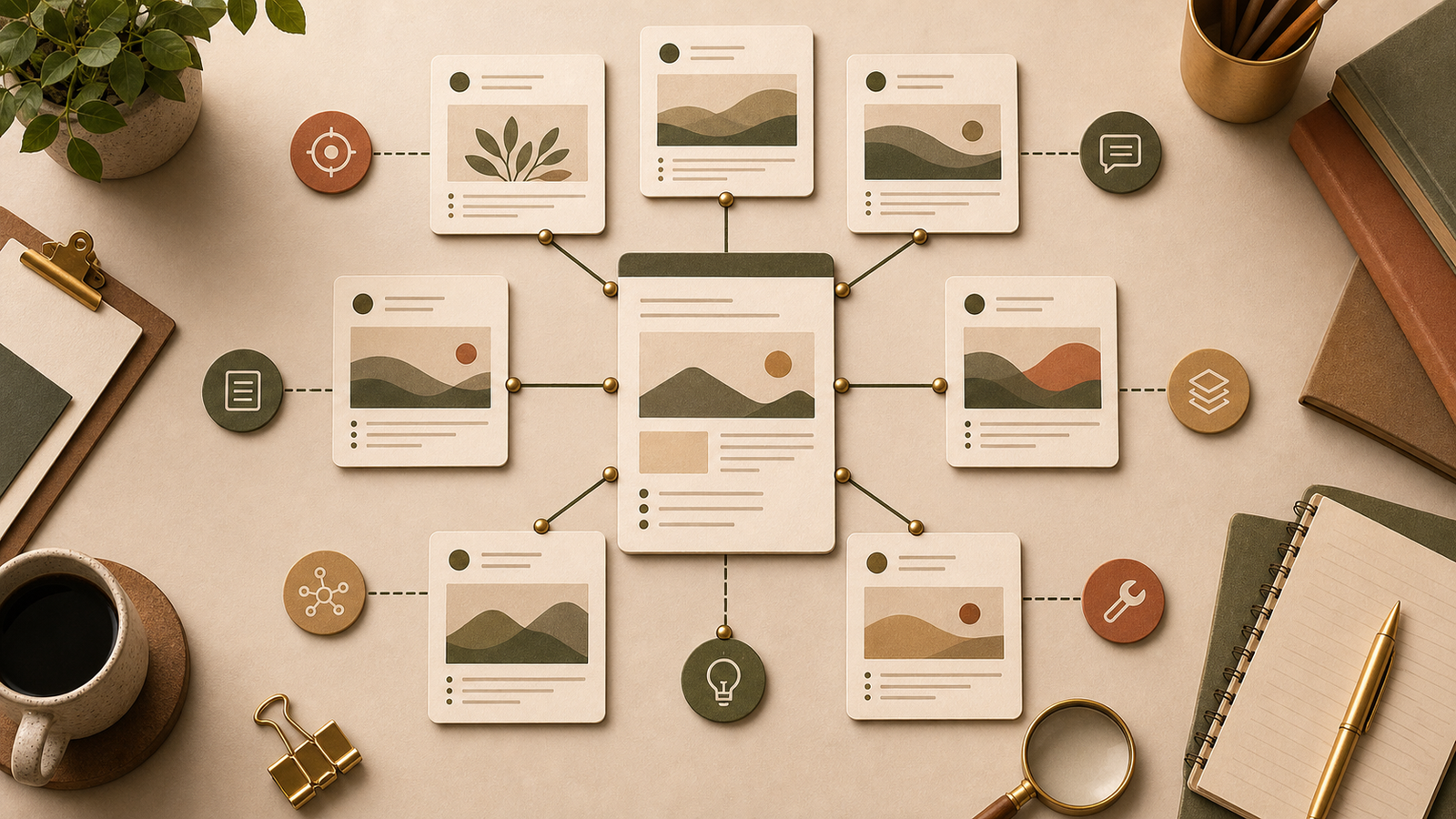
A topic cluster is a navigation system. It should show readers where to start, where to go deeper, and which resource helps them implement the idea.
Choose the hub topic and define the target reader.
List existing pages, planned resources, prompts, tools, and skills.
Ask AI to propose hub pages, supporting guides, templates, and refresh opportunities.
Assign every planned page a distinct search intent and reader next step.
Map internal links between hub, supporting guides, prompts, resources, and dashboard actions.
Review overlap and remove pages that would compete with each other.
Example prompt
Copy-ready prompt starter.
Use this prompt as a starting point, then customize the placeholders with your site, audience, and approved internal links.
Copy-ready prompt
Act as an SEO topic cluster strategist. Build a topic cluster for [HUB TOPIC] and [AUDIENCE] using these existing URLs [URLS] and planned resources [RESOURCES]. Include hub page, supporting guides, prompt pages, tool pages, free resource links, reader stage, search intent, internal links, overlap risks, and refresh opportunities. Do not create duplicate pages for the same intent.
Practical example
What this looks like in real work.
An AI SEO cluster can start with /ai-seo, then link to guides on search intent, content briefs, internal links, technical audits, and automation.
Each guide can point to the Prompt Library, SEO Content Agent, and free SEO Agent Skill Pack when the reader is ready to act.
Checklist
How to use AI to build topic clusters review checklist.
Use this checklist before turning the AI topic clusters workflow into a saved template, prompt, or article update.
Confirm this step has a reviewable output: Choose the hub topic and define the target reader.
Confirm this step has a reviewable output: List existing pages, planned resources, prompts, tools, and skills.
Confirm this step has a reviewable output: Ask AI to propose hub pages, supporting guides, templates, and refresh opportunities.
Confirm this step has a reviewable output: Assign every planned page a distinct search intent and reader next step.
Confirm this step has a reviewable output: Map internal links between hub, supporting guides, prompts, resources, and dashboard actions.
Confirm this step has a reviewable output: Review overlap and remove pages that would compete with each other.
Tools needed
Keep the stack simple and reviewable.
You need a hub topic, current URL inventory, planned resources, audience notes, and a place to map page relationships.
NEOA's AI SEO hub is an example of a cluster entry point that connects articles with free resources.
Mistakes to avoid
Where this workflow can go wrong.
For AI topic clusters, weak output usually looks polished while skipping context, verification, or reader-specific examples.
Treating a topic cluster as a keyword spreadsheet.
Creating multiple pages for the same reader intent.
Forgetting implementation pages such as prompts, tools, and free resources.
Skipping links from older pages to new cluster assets.
How to use this inside NEOA
Turn the workflow into a saved free-beta system.
Use the AI SEO hub as your model for connecting guides, prompts, skills, tools, and resource downloads.
Save your cluster map to the dashboard and return to it when adding new articles.
Recommended free NEOA resource
Browse the AI SEO hub
Use NEOA's free AI SEO hub to study how article clusters can connect to prompts, tools, skills, and free resources.
Related agent skill
SEO Content Agent Skill
A structured agent skill for turning a keyword into a full SEO content brief, article outline, metadata, FAQ schema plan, and social distribution assets.
Free NEOA resource
Browse the AI SEO hub
Use NEOA's free AI SEO hub to study how article clusters can connect to prompts, tools, skills, and free resources.
View resourceFree prompt pack
Get the prompt pack behind practical AI workflows.
Download 50 prompts for SEO, content, research, and business automation, then use them with this guide to make the workflow repeatable.
Free download
Get the prompt pack.
Choose your main interest and unlock the Markdown download.
Free during NEOA beta. You can download after submitting the form.
FAQ
Common questions
What is a topic cluster?
A topic cluster is a connected set of pages around a hub topic, usually including broad guides, supporting articles, tools, resources, and internal links.
Can AI choose all cluster pages?
AI can suggest pages, but you should review overlap, audience fit, credibility, and whether each page has a clear purpose.
How do internal links support topic clusters?
Internal links connect hub pages, supporting guides, prompts, tools, and resources so readers can move through the topic naturally.
Final recommendation
Make the workflow repeatable before you scale it.
Use AI to draft the cluster, then edit it until each page has a distinct purpose and a helpful next action.